Agentic development workstation
The board is the interface.
Every card is a running agent.
Not an assistant bolted onto a task list. Each card spawns a real Claude Code session in its own git worktree, on its own branch, with memory that survives the session and the teammate.
Simulation of the board. Real captures from a running install further down.
The problem
You have outgrown a single session.
One agent, one window, one branch. You wait while it works. You lose the thread when the context fills. What it learned about your codebase yesterday is gone today, and nothing it learned reaches the person sitting next to you.
Without coreCerebrum
Serial work
One task at a time. The agent is the bottleneck, and you are idle while it thinks.
Amnesia
Every session rediscovers the same conventions, the same gotchas, the same decisions.
With coreCerebrum
Parallel lanes
Many sessions at once, each on its own branch. You review instead of waiting.
Shared memory
Decisions and gotchas persist, and they reach the whole team, not just you.
The biggest win
We do not tell you it is cheaper. We show you what it cost.
Every competitor in this category talks about speed. None of them shows you token economics at all. coreCerebrum reads Claude Code's own per-turn transcript, attributes real tokens to individual tool calls, and keeps the context lean enough that most of it never gets paid for twice.
Where the waste goes
Agents burn tokens re-reading files they already read, re-deriving decisions that were settled last week, and hauling context that stopped being relevant twenty tool calls ago. That spend is invisible on every other board.
Re-read detection
The harness tracks what a session has already read and estimates the cost before it reads it again.
Memory recall
Past decisions and gotchas surface on the prompt that needs them, so they are not rediscovered from scratch.
Per-tool attribution
Real usage read from the transcript Claude Code actually sends. Not an estimate.
Parallel agent sessions
Every card runs a real Claude Code session. Not a queue, not a job runner. Many at once, each with its own context.
Worktree isolation
One git worktree per card, on its own branch. Agents cannot collide, and nothing lands on main by accident.
Persistent team memory
Decisions, conventions and gotchas outlive the session, and sync to the team rather than dying in one transcript.
Session control
Watch the diff, read the log, stop it, or take the wheel. The board is a control surface, not a status page.
Architecture
Isolation is the feature.
Parallelism without isolation is just a faster way to create merge conflicts. Every session gets a real worktree on a real branch, so ten agents working at once produce ten reviewable diffs, not one tangled working tree.
Full capability listReal interface
This is the product, not a rendering of it.
Captured from a running install. Card, project and session names are pseudonymized; the interface, the counts and the states are real.
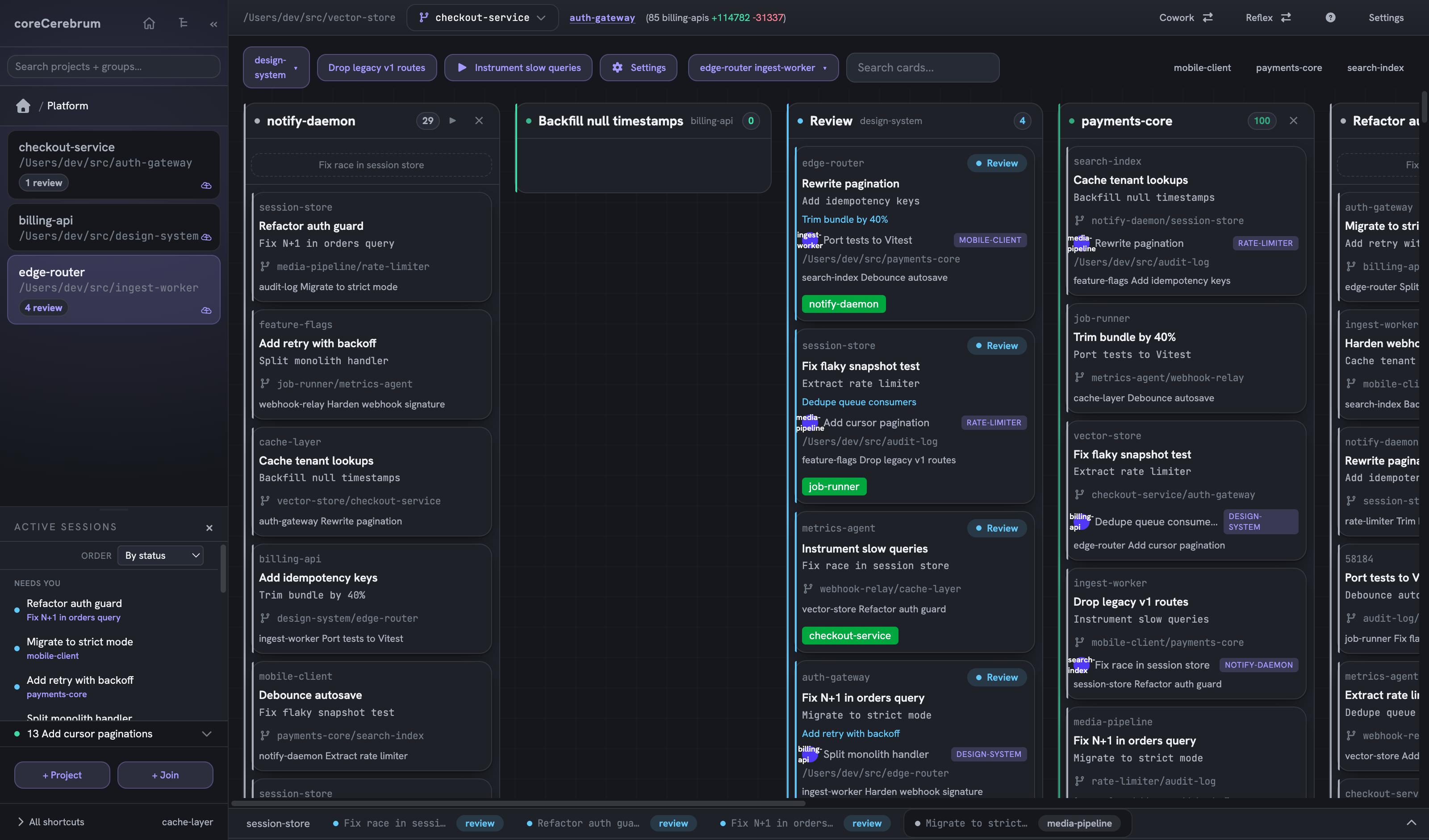
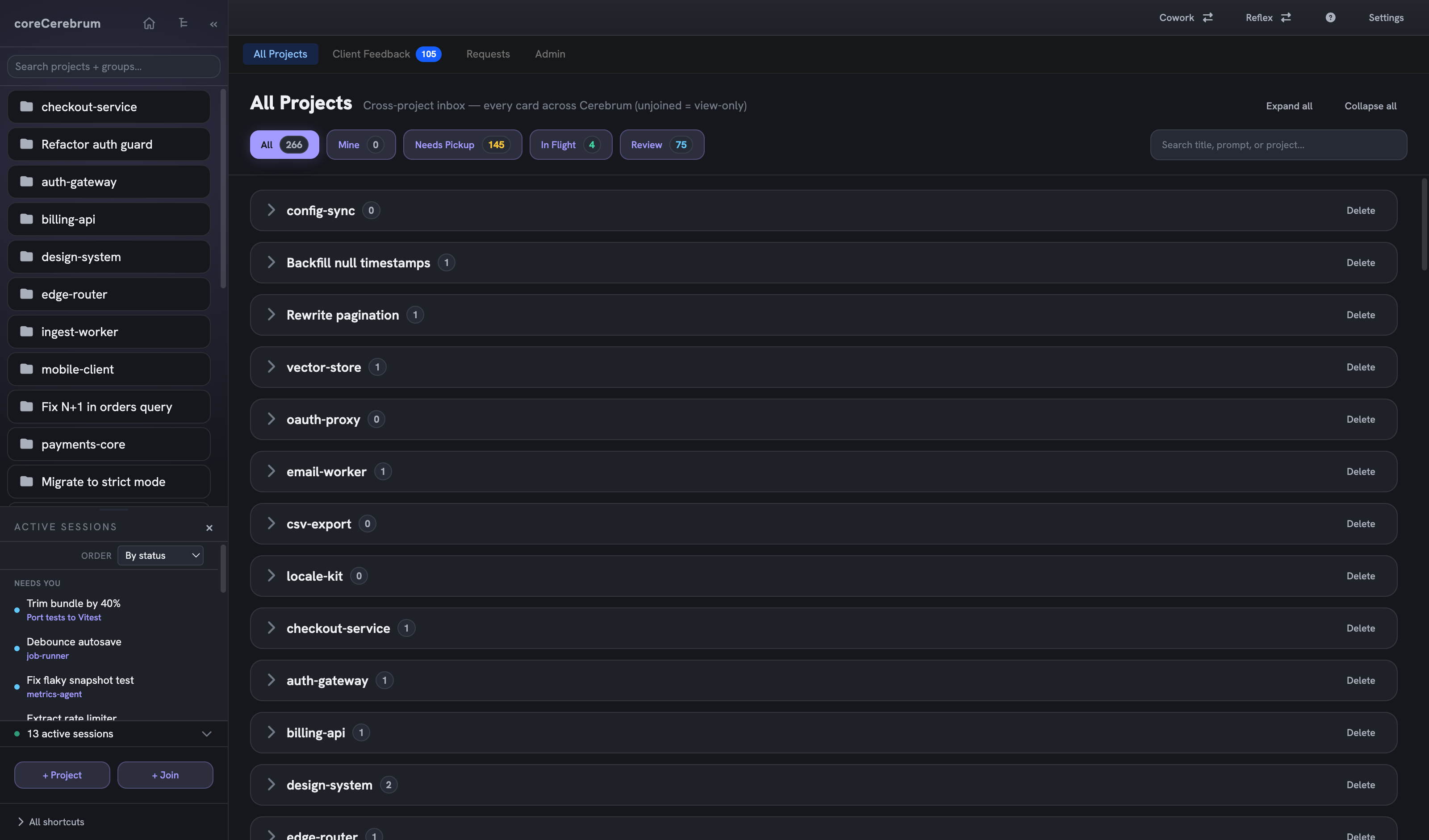
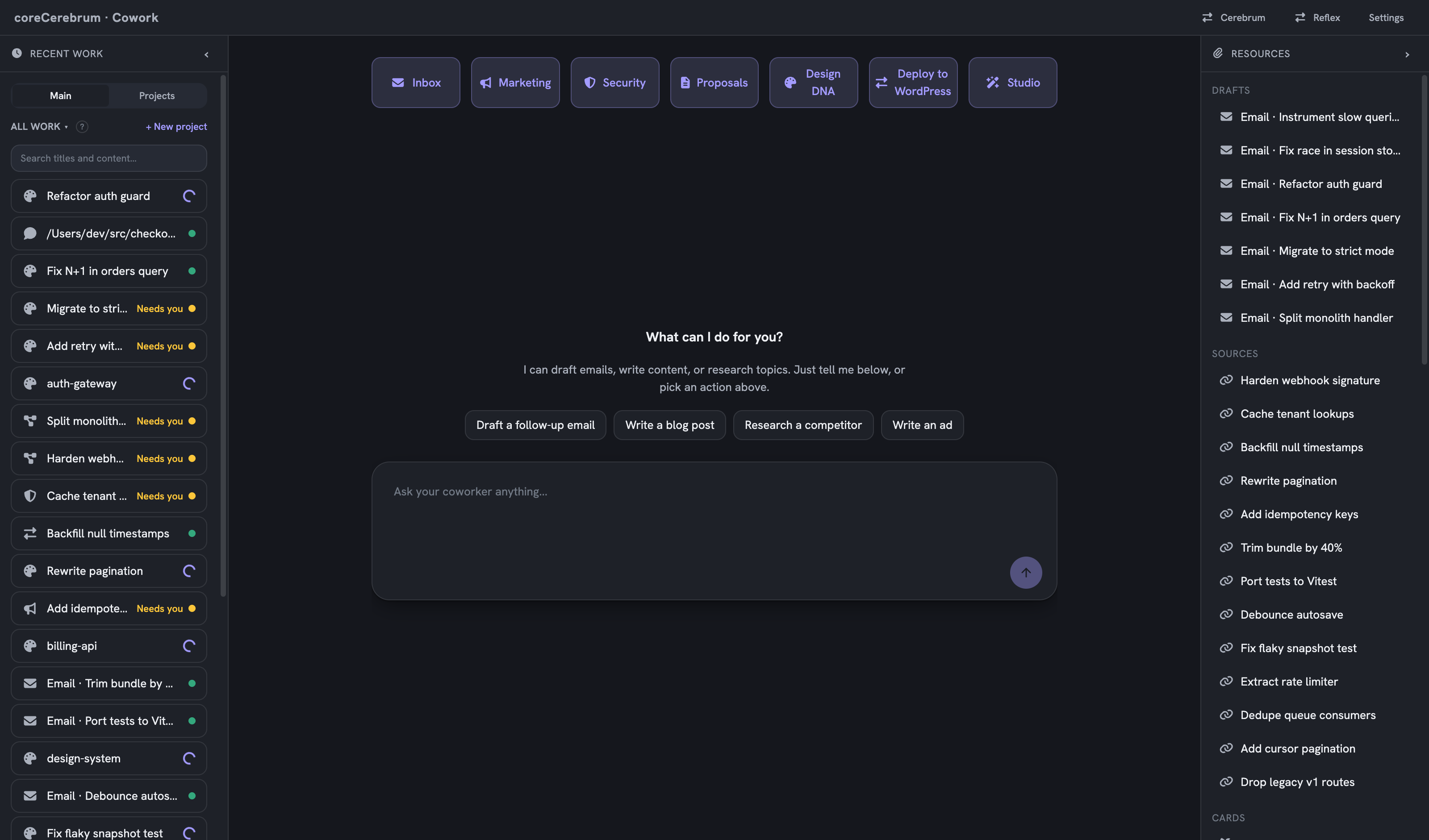
Underneath
Agents are only as good as the harness around them.
One shared configuration reaches every teammate identically: skills, commands, review agents, and a guard layer that refuses the operations you never want an agent to run.
Open the harnessDestructive operations are denied, not warned about
rm -rf /, force-push to main, DROP TABLE, chmod 777, pipe-to-shell, and hardcoded secrets in writes.
The bug log opens before the file does
Known failures and do-not-repeat entries for the exact file being edited, surfaced before the edit, plus a warning at three edits to one file.
Token spend attributed per tool
Read from the authoritative per-turn transcript, so the number is what was actually sent, not a guess.
Honest positioning
Running agents in parallel is table stakes now.
Several tools do that, and some of them are free. The difference is what survives when the session ends, and whether anyone can tell you what the work cost.
| Capability | Typical agent board | coreCerebrum |
|---|---|---|
| parallel sessions | Yes | Yes |
| worktree isolation | Yes | Yes |
| memory across sessions | Not offered | Persistent |
| memory across the team | Not offered | Synced |
| token and cost accounting | Not offered | Per tool, per turn |
| shared skills and commands | Not offered | 24 and 22 |
| destructive-operation guard | Not offered | Hard deny |
| docs sync | Not offered | Included |
"Typical agent board" reflects the published feature and pricing pages of the parallel-agent tools we compared in August 2026. Their pages name parallel agents, workspaces, cloud hours and collaboration. None of them names persistent memory, team memory, cost accounting, or a guard layer.